
Human Organ Factories in Space
How Astronauts 3D Print Living Tissues
Introduction: The Dream of Bioprinting Moves to Space
Have you ever dreamed of a world where patients don't have to wait for years on organ transplant lists, and instead have a new heart, liver, or cartilage "printed" on demand? This dream is coming remarkably close to reality. The surprise, however, is that the best place to manufacture these organs is not on Earth, but in outer space!
In an official scientific announcement published on November 17, 2026, NASA revealed details and images of a groundbreaking orbital experiment conducted in October 2026 aboard the International Space Station (ISS) orbital laboratory. During this experiment, NASA astronauts Dr. Jessica Watkins and Anil Menon successfully operated an advanced system known as the InSPA-Auxilium Bioprinter inside the station's sterile glovebox. They mixed living human cells with a special "bio-ink" to 3D print delicate human tissues, such as liver, kidney, and cartilage tissues.
How Do Scientists Make Living Tissue? (The Story of Bricks and Mortar)
Imagine you want to build a brick house; bricks alone will not stay stacked unless you put "mortar" between them to hold and support them. This is exactly what scientists do to build living human tissues, except instead of bricks and mortar, they use living cells and bio-ink.
- The Basic Ingredients (The Secret Formula)
To create human tissue (such as a piece of liver or ear cartilage), two essential elements are needed:
• Living Cells (The Bricks): Scientists take a tiny sample of cells from the human body, then place them in a lab to multiply and increase in number.
• Bio-ink (The Mortar and Food): This is not ordinary ink like the kind in pens! Rather, it is a gel-like substance (resembling clear jelly) made from natural, body-safe materials such as collagen. This "jelly" performs two roles: it holds the cells in place, and it acts as a nutrient-rich meal filled with vitamins and oxygen so the cells can survive and grow.
- How Does the Printer Work? (The Building Process)
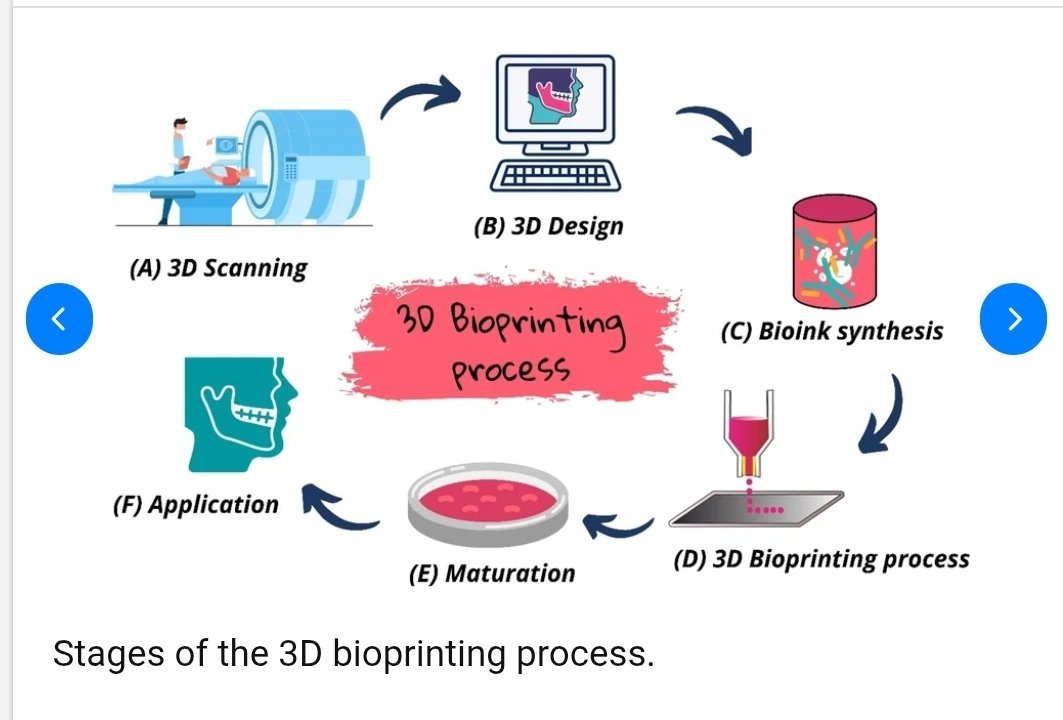
Scientists mix the living cells with the bio-ink and place the mixture inside a microscopic nozzle in a 3D printer.
• Precision Programming: The printer is programmed with the shape of the required tissue (for example, the shape of a piece of a heart).
• Layer-by-Layer Construction: The printer's nozzle begins drawing the shape layer upon layer with extreme precision, much like a pastry chef decorating a cake with icing, but on a microscopic scale!
Why Go to Space? (The Secret of Gravity)
Imagine building a tall tower out of soft "jelly" on a table at home; what would happen? The tower would melt and collapse downward due to its own weight and Earth's gravity. This is the exact challenge scientists face when trying to print human tissues in Earth-based laboratories.
• The Problem of Printing on Earth: When a printer tries to build soft human tissue layer by layer on Earth, gravity pulls these delicate cells downward, causing them to collapse onto one another and lose their precise geometric shape before they can solidify. To prevent this collapse, scientists have to print the cells inside rigid chemical molds or scaffolds—a complex step that can negatively affect the purity and quality of the tissue, often resulting in flat tissues or tissues of limited thickness.
• The Superpower of the International Space Station: In the weightless environment (microgravity) inside the orbital lab, the weight pulling the cells downward disappears. When cells exit the printer's nozzle in space, they float freely in place, bonding with one another naturally and uniformly in all directions without needing any external molds or scaffolds. The result is the formation of thick, complete 3D tissues that closely resemble real tissues growing inside the human body.
What Happens After Printing Is Complete?
Working carefully inside the isolated and sterile glovebox to ensure the purity of the experiment, astronauts Watkins and Menon monitor the crucial stages that follow once the InSPA-Auxilium Bioprinter finishes forming the tissue:
- The printed tissues are placed in warm incubators (mimicking human body temperature).
- After a few days, the "bio-ink" (the jelly) dissolves and disappears automatically after completing its job.
- The human cells remain bonded together to form real, living tissue pulsing with life.
Future Vision & Impact
This pioneering research aims to develop technologies that will eventually allow the printing of complete, transplantable human organs to be returned to Earth to save millions of patients on waiting lists, as well as providing immediate medical care for astronauts on long-duration missions to the Moon and Mars.